Theory

Academic Marxism Bidding Farewell to the Proletariat

For the success of the working class struggle the unity of two fundamental elements, namely the Marxist world view and the militant action of the working class, is essential. This unity has been profoundly shattered by the unfavourable conditions which began with the retreat of the revolutionary wave in Western Europe and which, especially after World War II, were characterised both by the dominance of Stalinism and by the resurgence of the capitalist system. Deprived for a long time of the revolutionary action of the working class, the “theory” degenerated and broke away from its true Marxist roots. Thus, a current of pseudo-Marxism, a direct product of these conditions of defeat, began to spread from the university chairs, especially in the Western European countries.


published on 18 June 2024

Preface

It is the globalised proletariat, not the “popular alliances” dominated by the petty-bourgeoisie, that is ringing the danger bells of the globalising capitalist order of exploitation. Our aim in this book is to clarify the reality of the working class in various aspects under the shining scientific light of Marxism. The plain truth revealed by this study, which is carried out on the basis of the analyses of Marxist theory without being deceived by the distortions of bourgeois statistics and without drowning the reader in figures, is this: The working class is growing, in spite of those who want to say goodbye to it or try to downplay it.

published on 13 June 2024

Globalisation: Uneven and Combined Capitalist Development /6

Capitalism’s law of uneven and combined development accelerates the globalisation of capital and formation of large economic unions, while at the same time producing even greater inequality and fierce competition. It is clear that the tendency towards unity, which is rooted in economic base, is doomed to be in conflict with the tendency towards competition, which is also rooted in the same source. As a matter of fact, today’s developments find their expression in the efforts of the great capitalist powers to expand their economic dominance, in their ambition to secure a superior position in the spheres of influence of rival powers and to create new spheres of influence. Imperialism has never brought a period of peace to the world, nor will it ever do so. The aggressive face of global capitalism is revealed in historical episodes when the given balances in the world are upset and serious crises of hegemony are experienced. Capitalism cannot move forward without resorting to imperialist wars of various types in order to redivide spheres of influence in the world, prevent the rise of rival powers or weaken their power.

published on 15 May 2024

Political Perspectives: World and Turkey - 2024

In the following document we, Marksist Tutum, present our perspectives and a general framework of our analyses of the political, economic and social developments in the world and Turkey, which will guide us in the period of struggle ahead.

published on 23 February 2024

Globalisation: Uneven and Combined Capitalist Development /4

One of the issues that needs to be carefully examined today is the view that imperialism, or globalisation as it is now called, is holding back underdeveloped countries and regions. Does the dominant position of capitalist countries, which are much more economically developed and powerful, really have a restraining and retarding effect on the economic development of backward countries?

published on 26 December 2023

Preface

It is clear that the analysis of the bourgeois state and its different forms is of central importance in Marxist theory. Based on the problems in this field, Marxist circles have over the years conducted debates and took different approaches. The differences in analyses on the extraordinary forms of rule of the bourgeois order create the need for a renewed focus on problems of Bonapartism and fascism, which are of great importance for the struggle of the working class today. The Bonapartist formation of the bourgeois state is not only a historical phenomenon that belongs to the past. Bonapartism is an important reality and a subject of discussion that is an extension of our recent history. In the same way, fascism, as the cruel attack of the capitalist order that once drenched the world in blood and inflicted so much suffering on the working class and toiling masses, is not buried in the pages of history books. Fascism is the counter-revolutionary form that the bourgeois state takes when it faces the threat of revolution in the age of imperialism.

published on 27 October 2023

Part 3

The form of establishment of the bourgeois order in Turkey has completely different characteristics than the development process of the bourgeois order in the Western European countries, where the classic examples of bourgeois revolutions are seen. In France, for instance, bourgeois development began yet in the feudal society, and the rising bourgeoisie, on the basis of private property, established its order by carrying out its own revolution in the following years. However, the historical development line of the Ottoman Empire, that the Republic of Turkey emerged out of, does not resemble that of France.

published on 20 October 2023

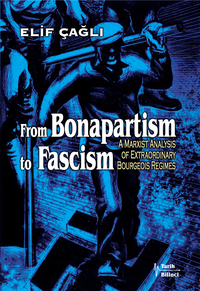
From Bonapartism to Fascism

A Marxist Analysis of Extraordinary Bourgeois Regimes
bf_-_onkapak-eng.png

In this book, Elif Çağlı, by taking into consideration a wide range of experiences ranging from Louise Bonaparte's experience of 18 Brumaire during the Marx era in France to the Bismarck era in Germany, from Italian and German fascism to Spain and Portugal, from Greece to Latin America, reveals the forms and evolutions of the extraordinary regimes of the bourgeoisie, how these regimes should be evaluated and on which theoretical-political foundations this evaluation should be based. Undoubtedly, the Turkish experience constitutes an important page here. Çağlı presents a Marxist perspective on the history of modern Turkey by discussing the establishment process and the subsequent evolution of the bourgeois regime in Turkey, the coups and the question of the character of the regimes they gave rise to.

published on 20 October 2023

Globalisation: Uneven and Combined Capitalist Development /2

Although capitalist development gradually created a single world market, this mode of production initially emerged only in a region with certain conditions, the West, where feudalism flourished. It is well known that human history does not have a uniform line of progress. While the feudal mode of production prevailed in the West, the Asian mode of production prevailed in the East. This mode of production, in which there was no private ownership of land, created vast and powerful despotic empires. Unlike the development in the West, these empires lacked the ability to undergo a capitalist transformation through their own internal dynamics.

published on 18 October 2023

History Calls On the Working Class for Duty

Many years have passed since the foundations of Marxism were laid. Through all these years capitalism has moved towards building a world system and inevitably has grown the working class into an enormous scale around the world. Under capitalism, history has still been a history of class struggles as had been the case with the history of previous class societies.

published on 22 December 2021

Forward to the Future with the Lessons of the Past

It is clear as day for those who succeed in drawing the lessons of the past and move forwards to the future: The experience so far does not demonstrate the downfall of Marxism, but of a conception of “socialism” that is its negation. As the end of the decaying capitalism comes closer, Marxism continues to guide humanity’s struggle for emancipation and happily foretells that the future lies in socialism.

published on 16 May 2021

Decaying Capitalism

Since it reached the stage of imperialism in early 20th century, capitalism has developed a global system of workings and global relations on the basis of the law of combined and uneven development. In the late 1980s and early 1990s, with the collapse of the bureaucratic regimes in the Soviet Union and elsewhere, huge markets such as Russia and China became integrated into capitalism, making the system global in the full sense of the word. This development brought forth a discussion that revolved around this new stage of capitalism.

published on 26 December 2020
Subscribe to %1